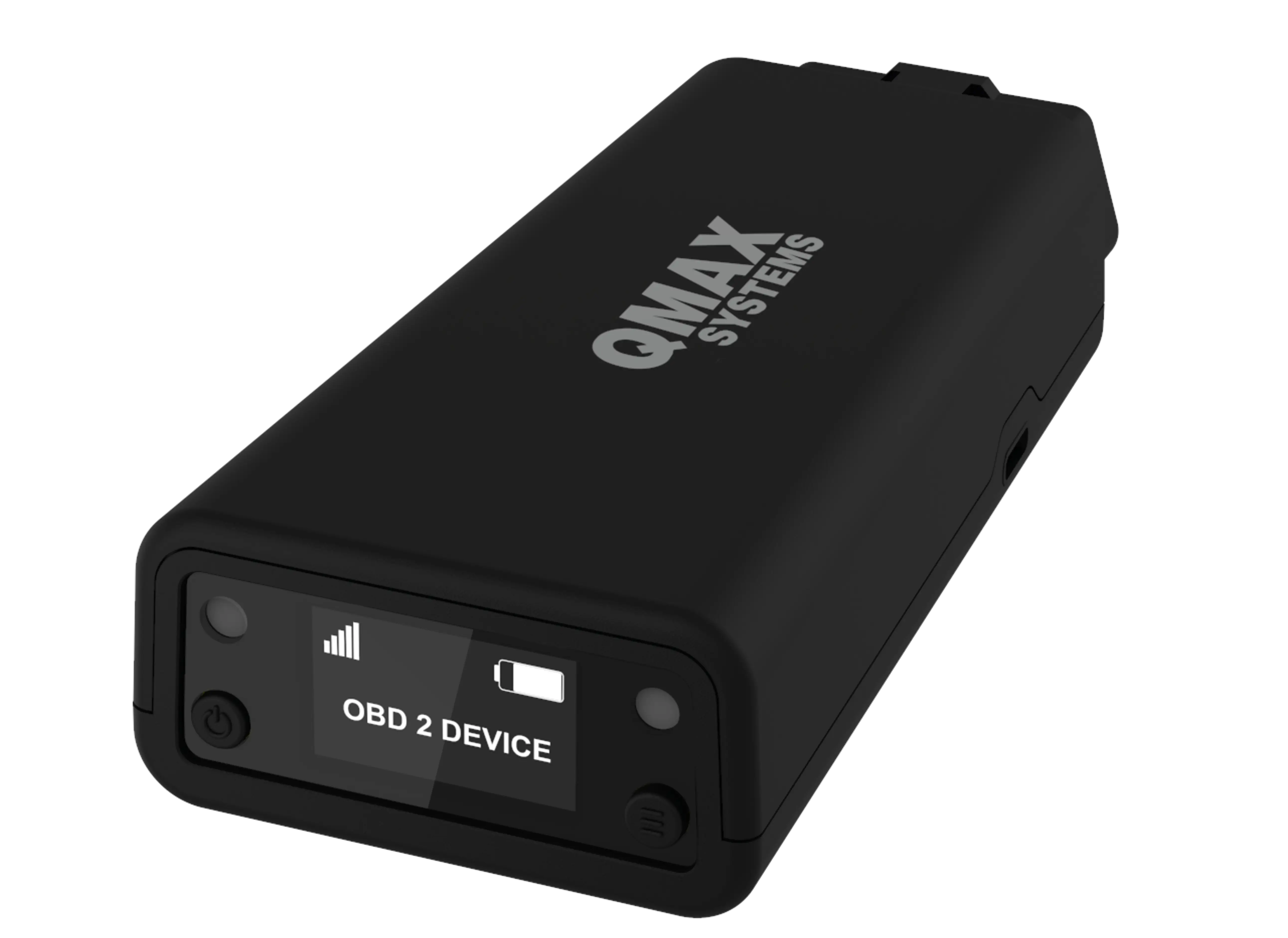
Rugged IP65 Handheld Enclosure for an OBD-II Diagnostics Device
Project Overview
A leading automotive retail SaaS provider in the USA wanted its own purpose-built hardware to acquire data directly from vehicles in dealership service lanes, and engaged Qmax Systems to develop the complete product. This case study focuses on the mechanical and industrial design of that device: a rugged, handheld OBD-II diagnostics unit engineered to survive daily professional use in automotive workshops. Qmax owned the mechanical workstream end to end — industrial design, enclosure engineering, material selection, DFM/DFA, tooling, prototyping, validation, and mass production support.
Product Brief
The device is a compact, handheld OBD-II diagnostics unit used by workshop technicians and service advisors: it plugs into a vehicle's OBD-II port the moment a car arrives and streams vehicle data to the cloud. Mechanically, that means a one-handed, pocketable form factor that lives a hard life — plugged and unplugged thousands of times, dropped onto concrete floors, tossed into toolboxes, and exposed to oil, dust, and washdown in the service lane.
The enclosure had to be IP65 sealed, drop-resistant, comfortable to grip, and attractive enough to sit customer-facing at the reception lane — all within a ~250 g handheld package measuring 130 × 60 × 30 mm.
Qmax Scope
Qmax Systems delivered the complete mechanical and industrial design scope for the handheld OBD-II diagnostics device:
- Industrial design and styling — custom ergonomic form factor for one-handed technician use
- Mechanical and structural enclosure design, including internal ribbing, bosses, and PCB mounting
- Material and finish selection — resins, seals, gaskets, overlays, and surface textures
- DFM/DFA and injection mold tooling design, including mold flow and gating strategy
- Prototyping through 3D-printed models for ergonomic and fitment iteration before tooling
- Mechanical validation (drop, vibration, thermal, ingress, life cycle) and mass production support
Design Challenges & Resolutions
Custom ergonomic form factor
Sculpted a compact, one-handed grip with balanced ~250 g weight distribution, validated through 3D-printed ergonomic prototypes with actual workshop users
IP65 sealing on a feature-dense handheld
Architected a complete sealing system of NBR O-rings at housing joints and silicone gaskets at every opening, verified by ingress testing
Drop and shock resistance for workshop life
ABS+PC enclosure with internal rib structures and shock-isolating PCB mounting, proven through repeated drop tests onto hard surfaces
Waterproofing functional openings
USB port, buttons, and display area each received dedicated gasketed sealing designs without compromising usability
Heat dissipation in a sealed enclosure
Managed internal electronics heat through conductive paths and material selection while keeping the housing fully vent-free for IP65
Antenna placement for multiple radios in a constrained space
Defined metal-free zones and keep-outs in the plastic architecture so RF performance survived the compact packaging, and supported SAR compliance for a handheld, body-worn use case
Custom OBD connector with integrated light pipe
Engineered a customized connector housing that channels status LED light to the plug-in point for at-a-glance feedback
Cosmetic quality and fitment
Hot gating for a smooth molded finish, matte surface texture chosen to conceal workshop scratches, and tight tolerance control for crisp edge finish and gap-free part fitment
Materials & Key Mechanical Components
ABS+PC blend enclosure
Chosen for its balance of impact strength, dimensional stability, and moldability; all materials selected for RoHS and California Prop 65 compliance
NBR O-rings
Compression sealing at the main housing joints for reliable IP65 performance
Silicone gaskets
Sealing of openings and interfaces, retaining elasticity across −20 to +55 °C
Polycarbonate display overlay
Scratch-resistant, optically clear protection for the display area
Matte textured mold finish
Conceals scratches and fingerprints while improving grip in oily workshop hands
Sealed Openings & External Interfaces
Customized OBD-II connector with integrated light pipe
The primary vehicle interface, engineered for thousands of insertion cycles
USB port
Gasket-sealed opening maintaining the IP65 rating
Buttons
Sealed actuator design with tactile feel preserved through the sealing membrane
Display window
Polycarbonate overlay bonded and gasketed into the front housing
Housing parting line
Continuous O-ring seal around the enclosure perimeter with controlled compression
Manufacturing & Production
Qmax supported the device from tooling through volume manufacturing:
Injection molding
All enclosure parts molded in ABS+PC, with hot gating (hot runner) for smooth, blemish-free cosmetic surfaces
In-house tooling design
Gating, draft, and parting line placement optimized for cosmetics and mold flow
DFM/DFA-driven assembly
Part consolidation and assembly design for fast, repeatable production assembly
Volume manufacturing
Scaled to volume manufacturing — thousands of units produced, packaged, and shipped to the customer
Testing & Validation
Mechanical qualification was performed on production-representative units:
- Drop and shock testing — Passed, confirming survival of workshop drops onto hard flooring
- Vibration and thermal cycling — Passed across the −20 to +55 °C operating range
- Water and dust ingress testing — IP65 rating verified per IEC 60529 on production-representative units
- Fatigue, SAR, and ergonomic trials — Life-cycle testing including connector insertion cycles, SAR testing for handheld use, and ergonomic usability trials — all passed
Technical Specifications
Summary
Qmax Systems delivered the complete mechanical and industrial design of a rugged, IP65-rated handheld OBD-II diagnostics device — from concept sketches and ergonomic prototypes through tooling, validation, and volume manufacturing. Thousands of units have been produced and deployed in dealership service lanes, with all mechanical validation targets met.
The project demonstrates Qmax's ability to take a demanding handheld product from industrial design to sealed, drop-proof, mass-manufactured reality — integrating ergonomic industrial design, IP-rated sealing architecture, RF-aware plastic engineering, and DFM/DFA-driven injection molding into a single mechanical workstream.
Qmax Systems delivers mechanical engineering end to end — industrial design, enclosure and structural design, material selection, DFM/DFA, injection mold tooling, prototyping, environmental validation, and mass production support.