Analog Engineering Where the Signal Is Smaller Than the Noise Around It
Qmax Systems designs the analog and mixed-signal hardware that turns physical phenomena into trustworthy data — precision front ends, high-resolution data acquisition, bio-signal chains, and measurement circuits that hold their accuracy in electrically hostile places. Our engineers take a system from noise budget and signal-chain architecture through schematic design, analog PCB layout, isolation and protection, bring-up and noise characterization, to a calibrated production release.
Precision analog is one strand of a wider schematic-level hardware design practice — the same engineers architect the digital, RF and power sections sitting alongside the signal chain on the same board. The hard part of analog design is rarely the amplifier. It is everything around it: where the return currents flow, what the switching regulator couples into the reference, how the layout behaves at the frequencies nobody specified. We treat noise as something to be located and stopped at its source, not something to be filtered downstream or corrected in software after the fact.
That discipline scales in both directions. A hearing aid and a kilowatt-class RF power supply are the same problem at different amplitudes — know where the noise comes from, keep it out of the measurement, and leave margin. Every program is owned by senior engineers from architecture through manufacturing handover, and you own 100% of the resulting intellectual property at every milestone.
Architecture & Noise Budget
Signal-chain architecture with target SNR, dynamic range and drift defined up front
Schematic Design
Front-end topology, conditioning, conversion and voltage reference design
Noise & Coupling Analysis
Coupling paths, return currents, PSRR and shielding strategy resolved before layout
Isolated measurement across high-voltage boundaries
Electrochemical impedance spectroscopy for battery health monitoring
Ultra-Low-Power & Wearable Analog
Battery-operated signal chains where measurement accuracy and multi-week runtime have to coexist rather than trade off.
Nano-ampere quiescent current across the full analog chain
Duty-cycled front ends and energy profiling
Coin-sized and body-worn sensor platforms
Wearable and IoT sensor nodes
Multi-rail partitioning that isolates analog from digital switching
Scientific & Test Instrumentation
Measurement-grade hardware for research, aerospace and industrial test, where the specification is the noise floor itself.
Ultra-low-noise amplification for aerospace and research instruments
Signal chains with characterized, measured noise performance
Precision voltage references and low-drift conditioning
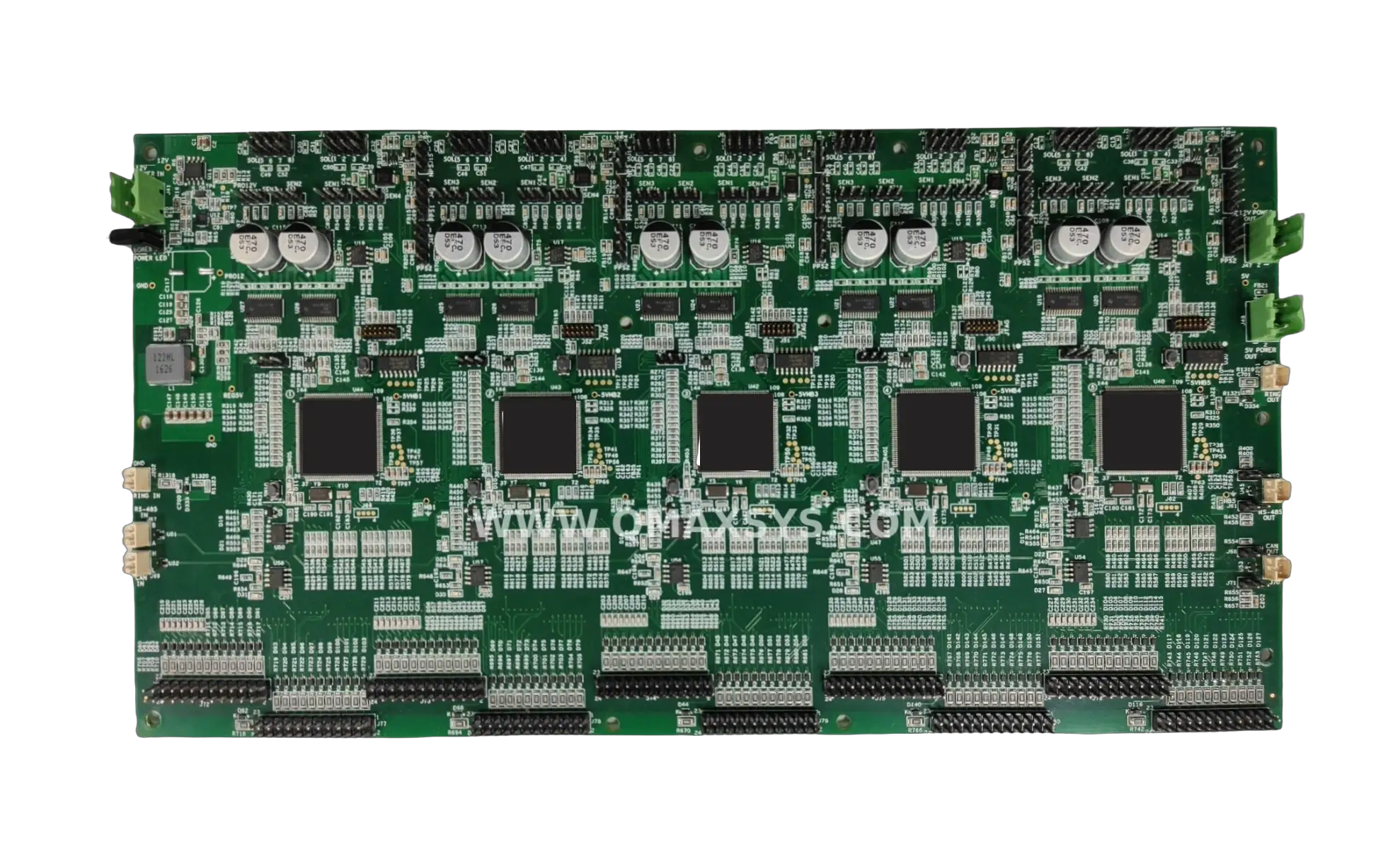
High-channel-count combined analog and digital I/O controllers
Calibration and traceability designed into the hardware
Silicon and Signal Chains We Work With
Domain
Silicon
Signal Chain & Interfaces
Precision Amplification
Analog Devices, Texas Instruments, Maxim
Instrumentation and charge amplifiers, zero-drift op-amps, programmable-gain stages, active filtering
Data Conversion
Texas Instruments ADS family, Analog Devices
16- to 24-bit SAR and delta-sigma ADCs, simultaneous-sampling arrays, high-speed DACs, JESD204B/C and LVDS
Bio-Signal & Acoustic
Analog Devices, Texas Instruments, Maxim, Silicon Labs EFM32
ECG, EMG, PPG and bio-impedance front ends, MEMS microphones, accelerometers
Processing & Real-Time DSP
NXP i.MX, ST, Nordic; AMD Xilinx and Intel Altera FPGAs
Multi-core Linux and Cortex-M acquisition, FPGA filtering, FFT and decimation at the edge
Isolation & Protection
Analog Devices, Texas Instruments, Broadcom
Digital and amplifier isolation, opto-isolated outputs, TVS and clamp networks on measurement inputs
Precision Power for Analog
Analog Devices, Texas Instruments, Infineon
LDO post-regulation, split-rail generation, low-noise voltage references, PSRR-driven rail design
Applications & Real-World Project Experience
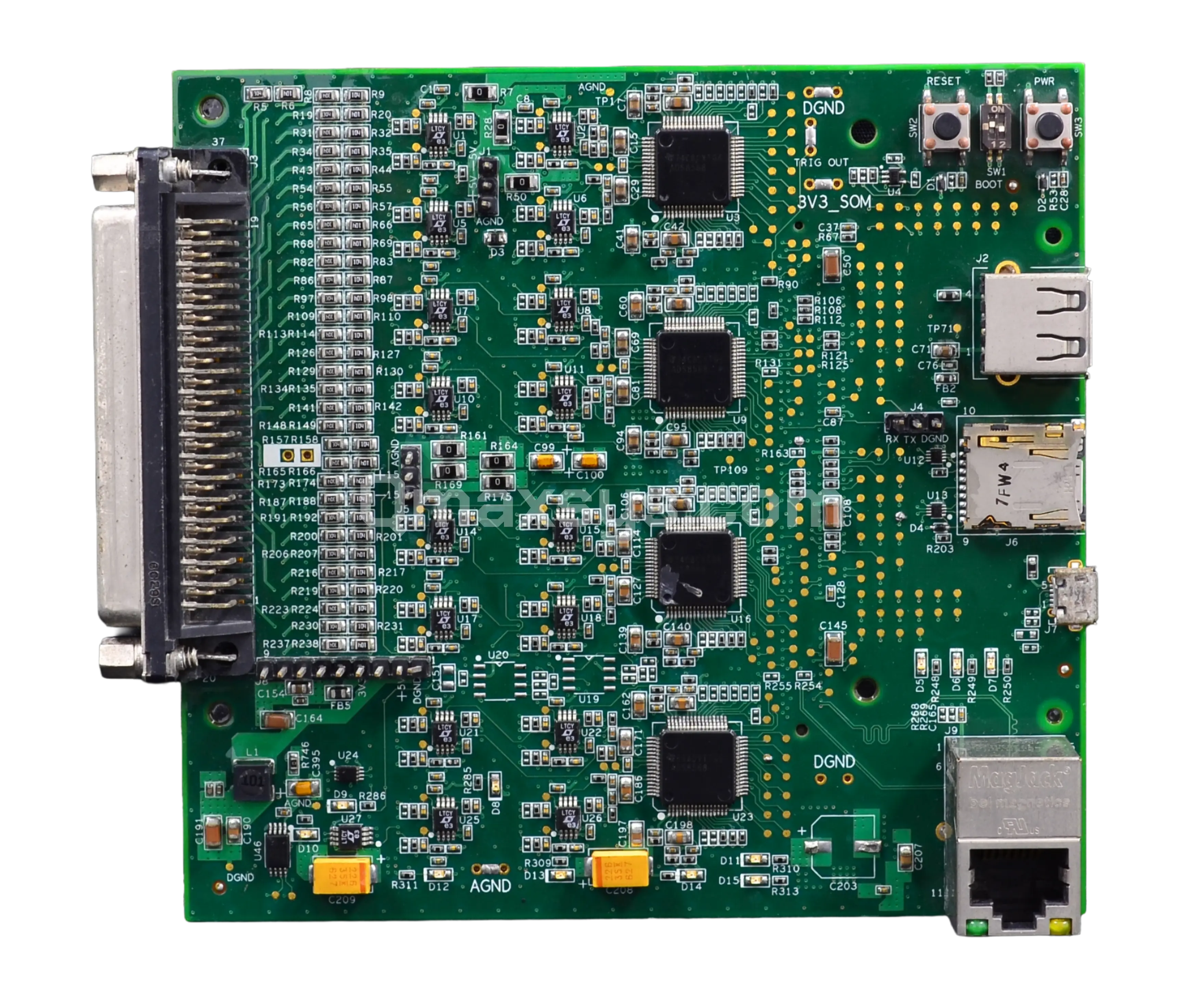
A 32-channel, 16-bit simultaneous-sampling data acquisition board that monitors piezoelectric sensors bonded to aircraft structures, capturing all channels in parallel at 30 KSPS with 90 dB SNR. A hardware trigger detects impacts and buffers capture, while a quad-core NXP i.MX6 running Linux streams data over Gigabit Ethernet.
This is a capacitive splice detection board for industrial web/material inspection, using a capacitive sense plate feeding a bridge filter, voltage follower, differential amplifier and comparator stage to detect splices in real time. Events are digitally processed and delivered through an opto-isolator to an isolated output for downstream control.
This is a compact, coin-sized wearable lung sound recorder that captures audio through dual MEMS microphones and motion data through an onboard accelerometer, processed by an EFM32 microcontroller and logged locally to an SD card. Powered by a battery-fed LDO regulator, it's accessed via USB-C, with UART debug and JTAG interfaces for diagnostics.
Click to zoom
1 / 2
Compliance & Standards
Qmax Systems builds for regulated industries, designing to stringent global standards so hardware holds up under medical, aerospace, and industrial certification.
Medical
ISO 13485 - quality management for medical devices
IEC 60601-1 - signal isolation and patient safety
Aerospace
MIL-STD-461 - EMI control requirements
DO-160 - environmental conditions and test procedures
Our first response to a noise problem is not a filter, and not a correction in software. It is to find where the noise is generated and contain it there — through domain partitioning, return-path control, shielding and grounding topology. Filtering and digital processing then recover what remains, rather than compensating for what should never have coupled in.
Four Decades of Analog Layout Experience
In analog and mixed-signal work the layout is part of the circuit, not a drawing of it. Our PCB designers have spent close to four decades on analog and mixed-signal boards, and the hardware designer and the layout designer work the same board together rather than in sequence — because a correct schematic laid out badly does not measure.
Measurement Next to the Noise Source
We design picofarad-level capacitance sensing and microampere-level current measurement immediately adjacent to high-power switching drivers. We have placed forward and reflected power sensing, working from a small reference signal, alongside kilowatt-class RF transmitters, and current sensing in the middle of converters switching thousands of amperes.
A Full Noise-Control Toolkit
Filter selection, noise containment, isolation, shielding, suppression at source and immunity hardening are treated as distinct disciplines, each chosen against a measured noise floor and a target dynamic range — not applied as a default set and hoped over.
From Hearing Aids to Kilowatt RF
The same discipline scales in both directions. Our work runs from high-end scientific instruments and aerospace measurement systems through to medical sensors, hearing aids and wearables — and the reason one team can cover that range is that the underlying problem does not change with the amplitude.
ISO 9001 and ISO 13485 Certified Process
Analog design punishes small oversights, and they are expensive to find late. Qmax operates ISO 9001 and ISO 13485 certified quality systems, with defined internal process steps and review gates built specifically to catch mistakes before a design reaches fabrication.
Get a Complimentary Consultation with Our Analog & Mixed-Signal Experts
A one-hour session with a Qmax Systems Senior Hardware Architect. Bring a noise floor you cannot reach, a signal chain that drifts, or a front end that has to sit next to something loud. Practical and engineering-driven — no sales pitch. We can sign an NDA beforehand.
How does Qmax Systems stop digital switching noise from corrupting sensitive analog signals?
Qmax Systems treats noise as something to contain at its source rather than filter downstream. The techniques are selected against the target noise floor and dynamic range, not applied as a fixed recipe: moat-and-bridge PCB structures, Faraday shielding, dedicated reference planes, deliberate return-path routing, guard traces around high-impedance nodes, and split-rail power architectures with LDO post-regulation. Filtering and digital processing then clean up what remains, instead of compensating for coupling that could have been prevented in layout.
Can Qmax Systems design analog sensing inside high-power switching environments?
Yes, and it is one of our strongest areas. Qmax Systems has designed current and voltage sensing inside power converters switching thousands of amperes, forward and reflected power measurement recovering a small reference signal alongside kilowatt-class RF transmitters, and picofarad-level capacitance sensing immediately adjacent to high-power switching drivers. This work depends on domain partitioning, galvanic isolation and grounding topology rather than on filtering after the fact.
What sensor types does Qmax Systems design analog front ends for?
Qmax Systems designs precision front ends for capacitive, inductive, resistive, piezoelectric, bio-potential, optical and acoustic transducers, using instrumentation amplifiers, charge amplifiers and bridge front ends. These are optimized for signal-to-noise ratio and spurious-free dynamic range, and appear in aerospace structural monitoring, industrial inspection, medical instrumentation, load and tension measurement, and process control systems.
What ADC and DAC resolutions does Qmax Systems integrate?
Qmax Systems integrates high-resolution ADCs up to 24-bit and high-speed DACs with FPGAs and SoCs, including multi-channel simultaneous-sampling arrays. Recent work includes a 32-channel, 16-bit platform sampling every channel in parallel at 30 KSPS with 90 dB SNR. We handle JESD204B/C interface timing, LVDS signaling, deterministic latency and lane skew compensation between converters and their FPGA or SoC host.
Does Qmax Systems design low-power analog for wearables and battery-operated devices?
Yes. Qmax Systems designs ultra-low-power analog achieving nano-ampere quiescent currents without compromising signal fidelity, for medical monitoring patches, hearables and hearing aids, fitness wearables, IoT sensor nodes and continuous-monitoring platforms. Duty-cycled front ends, deep-sleep wake sources and multi-rail partitioning are designed together, so battery life is engineered rather than measured after the fact.
How does Qmax Systems handle medical device requirements for analog front ends?
Qmax Systems operates an ISO 13485 certified quality system and designs bio-signal front ends with patient isolation, leakage-current control and creepage and clearance treated as architecture constraints from the outset, in line with IEC 60601-1. Bio-potential and acoustic work spans ECG, EMG, PPG, bio-impedance, oximetry and MEMS microphone chains.
How does Qmax Systems characterize and verify noise performance?
Noise targets are set as a budget before layout and measured against that budget at bring-up. Verification covers input-referred noise, signal-to-noise ratio, spurious-free dynamic range, linearity, channel-to-channel crosstalk and thermal drift, measured on the assembled board rather than inferred from datasheet figures. Where a target is missed, the coupling path is located and corrected in hardware rather than masked in firmware.
Does Qmax Systems provide board bring-up and analog debug?
Yes. Hardware, layout and firmware engineers work in the same delivery center, so bring-up is handled by the team that designed the board. Analog debug covers rail noise and PSRR verification, reference stability, noise-floor measurement, probing for coupling paths and crosstalk, converter timing validation, and calibration through to design validation testing.
How does Qmax Systems manage component obsolescence and supply risk on precision parts?
Component lifecycle is assessed during schematic design. Precision analog parts are the hardest to substitute late, because a replacement amplifier or reference with different noise, drift or bias characteristics changes the measurement. Qmax Systems screens for end-of-life and not-recommended-for-new-design parts up front, identifies alternates on the parameters that actually matter to the signal chain rather than on pin compatibility alone, and validates every symbol, footprint and 3D model against the manufacturer datasheet.
Can Qmax Systems take over an analog design that is not meeting its noise target?
Yes, and it is a common way our engagements start. Typical work includes independent review of the schematic and layout, measurement of the actual noise floor against the intended budget, locating the dominant coupling path through probing and selective rework, and a corrective design package addressing partitioning, grounding, shielding or rail design. Where original design data is unavailable, Qmax Systems can reconstruct schematics and CAD databases from the physical assembly.