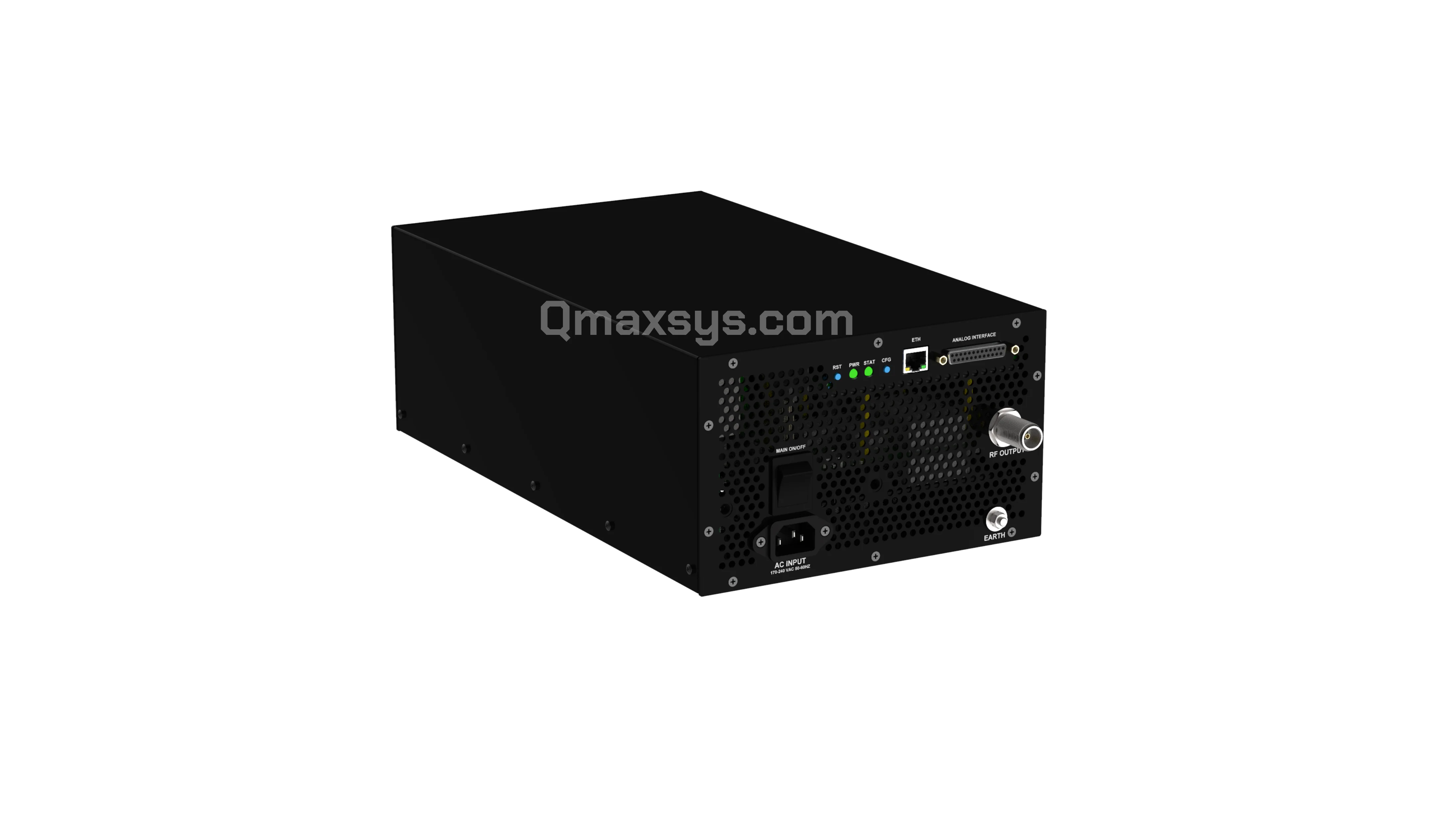
EMI-Shielded Enclosure Design for a 1 kW RF Plasma Generator
Project Overview
An OEM supplying plasma-generation equipment to the semiconductor industry approached Qmax Systems with a clear business problem: comparable RF generators on the market were expensive and carried long lead times, and the company wanted its own product. Qmax developed the complete 1 kW RF plasma generator; this case study covers the mechanical engineering — an enclosure where every panel, shield, heatsink, and even fastener behaves as an RF component. Qmax owned the mechanical workstream end to end: enclosure architecture, multi-layer EMI shielding design, thermal and airflow engineering, sheet-metal DFM, prototyping, compliance testing support through TÜV certification, and production.
For the complete electronics and firmware story, see the RF Signal Generator Enclosure full product development case study at /case-studies/rf-signal-generator-enclosure.
Product Brief
The product is a 1000 W RF generator producing cold plasma for wafer cleaning in semiconductor manufacturing — a half-width 3U rack-mount industrial controller that runs continuously at full power. Mechanically, it is one of the hardest classes of enclosure to engineer: kilowatt-level RF must be contained inside a chassis that simultaneously breathes enough air to cool a large RF transformer and power stages, while the instrument itself sits beside a plasma chamber radiating massive external RF that must be kept out.
Shielding, cooling, safety isolation, and serviceability all compete for the same sheet metal — and the enclosure had to clear EMC and safety certification at Class A industrial levels.
Qmax Scope
Qmax Systems delivered the complete mechanical engineering scope for the 1 kW RF plasma generator:
- Mechanical architecture of a half-width 3U rack enclosure for continuous kilowatt-class RF operation
- Three-layer EMI shielding design — enclosure, internal shields, and module-level segregation engineered jointly by mechanical and RF engineers
- Thermal and airflow engineering — end-to-end forced-air path with acoustic noise management
- Material and finish selection for shielding effectiveness, grounding, and industrial durability
- Sheet-metal DFM, prototyping, and modular assembly design for production and field service
- Testing and validation through EMC, safety, and thermal programs to TÜV certification and volume manufacturing
Design Challenges & Resolutions
Containing kilowatt-level RF emissions
At kW power, even small enclosure gaps leak enough RF to fail radiated emission limits; a three-layer shielding architecture (grounded enclosure, internal copper/steel shields, and module segregation) achieved EN 55011 / CISPR 11 Class A, Group 2 and EN 55032 Class A compliance
Shielding that breathes
An engineered stainless steel honeycomb vent acts as a waveguide-below-cutoff barrier: cooling air flows freely through it while kilowatt-level RF cannot escape
One part, three jobs
An innovative skived copper heatsink was engineered to serve simultaneously as heatsink, RF shield, and electrical reference plane, saving space and parts while improving both thermal and EMI performance
Dissipating heavy RF transformer heat
The heatsink and duct geometry were shaped so the transformer's heat is swept into the main airflow path without opening shielding gaps, supporting continuous full-power operation
End-to-end airflow design
Air enters one end of the chassis and exits the other, sweeping every module in sequence with high-speed fans, with duct shaping to keep airflow acoustic noise low
High-voltage safety isolation
Multiple HV points required controlled clearance and creepage distances in the mechanical layout, meeting EN 61010-1 electrical safety with proper grounding provisions
Mechanical parts as RF components
Shields were designed to avoid altering the electrical characteristics of inductors and transmission lines; enclosure panels, heatsinks, screws, and wire routing were all treated as part of the RF circuit, with mechanical and RF engineers designing together, down to module orientation
Immunity in a hostile RF environment
The generator operates beside a plasma chamber radiating massive RF; the same shielding system blocks external interference from entering, meeting EN 55035 immunity requirements
Materials & Key Mechanical Components
Powder-coated MS sheet-metal enclosure
Rigid, cost-effective industrial housing with a durable finish
Tin-plated, grounded MS internal chassis surfaces
Low-impedance, corrosion-stable metal-to-metal bonding for shielding effectiveness
Skived copper heatsink
Chosen for maximum thermal conductivity while doubling as RF shield and reference plane
Stainless steel honeycomb vent panels
EMI-tight ventilation at kilowatt RF power levels
Copper and steel internal shield partitions
Section-by-section RF segregation inside the managed airflow path, with high-speed cooling fans
Sealed Openings & External Interfaces
RF output connector
Precision panel opening with 360° shield bonding at the primary power interface
Honeycomb air intake and exhaust panels
The only large openings in the chassis, EMI-sealed by design
AC power inlet and control/interface connector cutouts
Filtered, gasketed penetrations preserving shield integrity
Chassis grounding provisions
Dedicated bonding points supporting safety and EMC performance
Rack integration and panel marking
Half-width 3U mounting features with laser-engraved and screen-printed panel identification
Manufacturing & Production
Qmax supported the enclosure from sheet-metal prototyping through production deployment:
Precision sheet-metal fabrication
Enclosure, internal shields, and mounting structures fabricated to tight tolerances
Finishing chain
Tin plating (conductive internal surfaces) and powder coating (exterior), with laser engraving and screen printing for panel marking
Modular mechanical architecture
SMPS, digital control, RF amplifier, and filter sections built as separate modules for fast assembly and easy field maintenance
Volume production
Production units manufactured and deployed in the field following TÜV certification
Testing & Validation
Compliance testing support through TÜV certification on production-representative units:
- Radiated and conducted emissions — Passed EN 55011 / CISPR 11 (Class A, Group 2) and EN 55032 Class A
- EMC immunity — Passed EN 55035, validating operation beside high-power plasma chambers
- Electrical safety — Met EN 61010-1 with TÜV certification completed
- Thermal cycling — Continuous full-power operation across 0 to +60 °C — passed
Technical Specifications
Summary
Qmax Systems delivered the complete mechanical design of a 1 kW RF plasma generator — a TÜV-certified, half-width 3U rack enclosure in which the sheet metal, shields, honeycomb vents, and a triple-duty skived copper heatsink work together as both a cooling system and an RF circuit. The product cleared Class A industrial EMC and EN 61010-1 safety requirements, and is manufactured and deployed in semiconductor fabs, giving the customer a cost-effective, readily available alternative to expensive long-lead-time incumbents.
The project demonstrates Qmax's rare combination of mechanical, thermal, and RF shielding engineering under one roof — treating every enclosure panel, heatsink, vent, and fastener as part of the RF circuit while delivering forced-air cooling, high-voltage safety isolation, and modular serviceability in a single 3U chassis.
Qmax Systems engineers EMI-shielded enclosures, thermal and airflow architectures, and sheet-metal designs for high-power RF, industrial, and semiconductor equipment — from concept through EMC/safety certification and volume production.