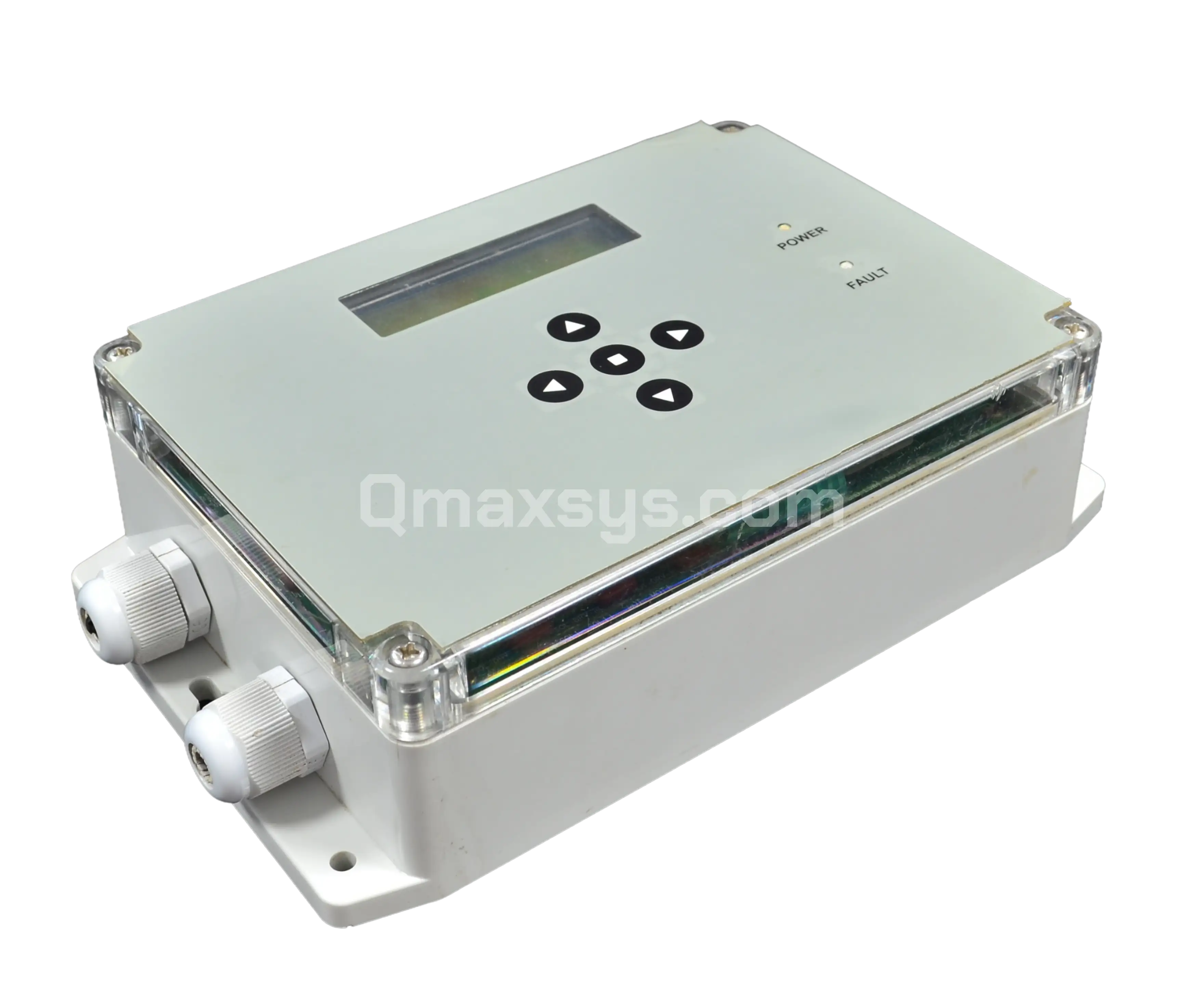
Smart Lubrication Controller for Rail & Metro Applications
Project Overview
Qmax Systems designed and delivered a Smart Lubrication Controller — a rugged, cloud-connected embedded system that automates rail track lubrication for railway and metro rail installations. The customer, a lubrication systems and equipment manufacturer, came to Qmax with a requirement to build electronics that meet railway-grade environmental standards.
Qmax delivered the complete electronics development — architecture, hardware, firmware, PCB design, IP65 enclosure design, EVT, full DVT, and prototypes — and supported the transition to volume production. The customer has since manufactured 1000+ units, deployed across railway and metro rail projects throughout India, including remote off-grid locations.
Product Brief
The Smart Lubrication Controller manages track-side lubrication equipment: it senses passing train wheels, counts axles, and precisely actuates the lubrication pump and solenoid valves so grease is applied only when and where needed. Built around a Microchip PIC18 low-power microcontroller, it integrates BLE for on-site commissioning from a mobile phone, GSM connectivity for cloud-based remote monitoring, a character LCD with keypad navigation for local configuration, and battery-backed RTC-based scheduling and logging.
Housed in an IP65 enclosure, the controller is engineered for continuous operation track-side — withstanding extreme vibration, temperature swings, and exposure to high-voltage spikes and surges near electrified lines.
Scope of Work
Qmax Systems executed the complete electronics development lifecycle for this railway-grade lubrication platform:
- End-to-end system architecture definition to meet railway-grade environmental requirements
- Hardware design of a low-power, surge-hardened embedded controller platform
- Firmware development in bare-metal C on a Microchip PIC18 MCU using MPLAB X IDE
- Android application development for commissioning and remote diagnostics over BLE
- 2-layer PCB design optimized for cost, EMI robustness, and volume manufacturing
- IP65 enclosure design for harsh outdoor track-side deployment
- Prototype manufacturing, EVT, and full Design Verification Testing (DVT)
- Volume production support scaling to 1000+ deployed units
Engineering Challenges
Surviving high-voltage spikes and surges near electrified railway tracks
Implemented layered TVS diodes, zener clamping, and fused protection on every field input and power rail, with a 15 A fuse and ESD arrays hardening all 14 field I/O channels against track-side electrical events
Reliable wheel detection and counting under extreme vibration and all-weather outdoor conditions
Developed debounced wheel-count and train detection firmware with noise filtering tuned for track-side sensor inputs operating under continuous vibration and variable weather
Achieving ultra-low standby power for solar-powered operation at remote, off-grid sites
Designed a low-power PIC18F66J94-based platform with optimized sleep/wake cycles and efficient power regulation, enabling sustained operation from solar supplies at remote rail sections
Maintaining GSM cloud connectivity from remote locations with weak, intermittent networks
Built a resilient GSM telemetry stack with buffered event logging and retry logic, ensuring pump status, pressure, and wheel-count data reaches the cloud even over intermittent GPRS links
Integrating BLE, GSM, LCD, sensor inputs, and relay loads on a compact 2-layer board without EMI issues
Applied EMI-conscious 2-layer PCB layout with careful RF module placement, ground partitioning, and signal routing to co-locate BLE, GSM, LCD, and relay drive circuits without cross-interference
Designing an IP65-sealed enclosure while managing antenna performance and thermal behavior
Engineered an IP65 outdoor enclosure with antenna placement validated for BLE and GSM performance, and thermal design suited to continuous track-side operation across temperature extremes
Ensuring accurate, battery-backed time-keeping and event logging through power outages
Integrated an NXP PCF85263 RTC with 32.768 kHz crystal and lithium coin-cell backup, paired with 2-Mbit I2C EEPROM for non-volatile configuration and event log retention through power loss
Building a field-friendly commissioning flow usable by non-technical maintenance crews
Delivered a BLE-connected Android commissioning app and an on-device LCD menu system with 5-way keypad navigation, enabling local setup and remote diagnostics without specialized tools
Hardware Components
PIC18F66J94
Microchip low-power microcontroller (TQFP-64) — central control and lubrication logic
CC2541-based BLE Module
Texas Instruments BLE radio for mobile phone commissioning and field diagnostics
Quad-band GSM/GPRS Modem
Cellular modem module with SIM interface for cloud telemetry and remote monitoring
PCF85263 RTC
NXP real-time clock with 32.768 kHz crystal and lithium coin-cell backup for scheduling and logging
2-Mbit I2C EEPROM
Non-volatile storage for configuration, calibration, and event log data
Power Relays
Relay outputs for lubrication pump motor and solenoid valve actuation
Character LCD + Keypad
Local display module with level translator and 5-way keypad for on-site configuration
Multi-Stage Protection
15 A fuse, TVS diodes, zener clamps, and ESD arrays on all field I/O and power rails
Interfaces & Protocols
Wheel Count Sensor
Train detection and axle counting for lubrication trigger logic
Proximity Sensor
Equipment position and presence sensing
Pressure Switch / Transmitter
Grease line pressure monitoring
Limit Switch Inputs (10×)
System status and level monitoring
Relay Outputs
Lubrication pump motor and solenoid valve drive
BLE
Mobile app-based commissioning, configuration, and diagnostics
GSM/GPRS
Cloud telemetry for remote monitoring of pump status, pressure, and wheel counts
USB / LCD / Keypad / Buzzer
USB-UART bridge for service access, LCD + keypad for local setup, and buzzer/LED indication
Firmware & Software
Bare-metal C firmware on Microchip PIC18 developed using MPLAB X IDE, with companion Android application:
Wheel Counting & Train Detection
Debounce and noise filtering logic for reliable track-side sensor inputs under vibration
Lubrication Control Algorithms
Wheel-count and schedule-based pump and solenoid actuation for precise grease application
BLE Protocol & Android App
BLE communication stack and Android application for commissioning and remote diagnostics
GSM Cloud Telemetry
Periodic upload of pump run status, pressure, grease events, and wheel counts to cloud platform
RTC Scheduling & Event Logging
Battery-backed time-keeping, scheduled operation, and non-volatile configuration management
LCD Menu System
Keypad-navigated on-device menus for local setup without external tools
Fault Recovery
Watchdog, brown-out detection, and fault-recovery mechanisms for unattended remote operation
Technical Specifications
Summary
Qmax Systems delivered a complete railway-grade Smart Lubrication Controller — from architecture and hardware through firmware, Android application, enclosure design, DVT, and volume production support. The result is a rugged, cloud-connected controller that reliably automates track lubrication in some of the harshest outdoor environments, from metro networks to remote off-grid rail sections.
With 1000+ units deployed across India, the product demonstrates Qmax's ability to take demanding industrial IoT products from concept to the field — combining surge-hardened hardware, low-power embedded firmware, wireless connectivity, and field-friendly commissioning tools in a single railway-grade platform.