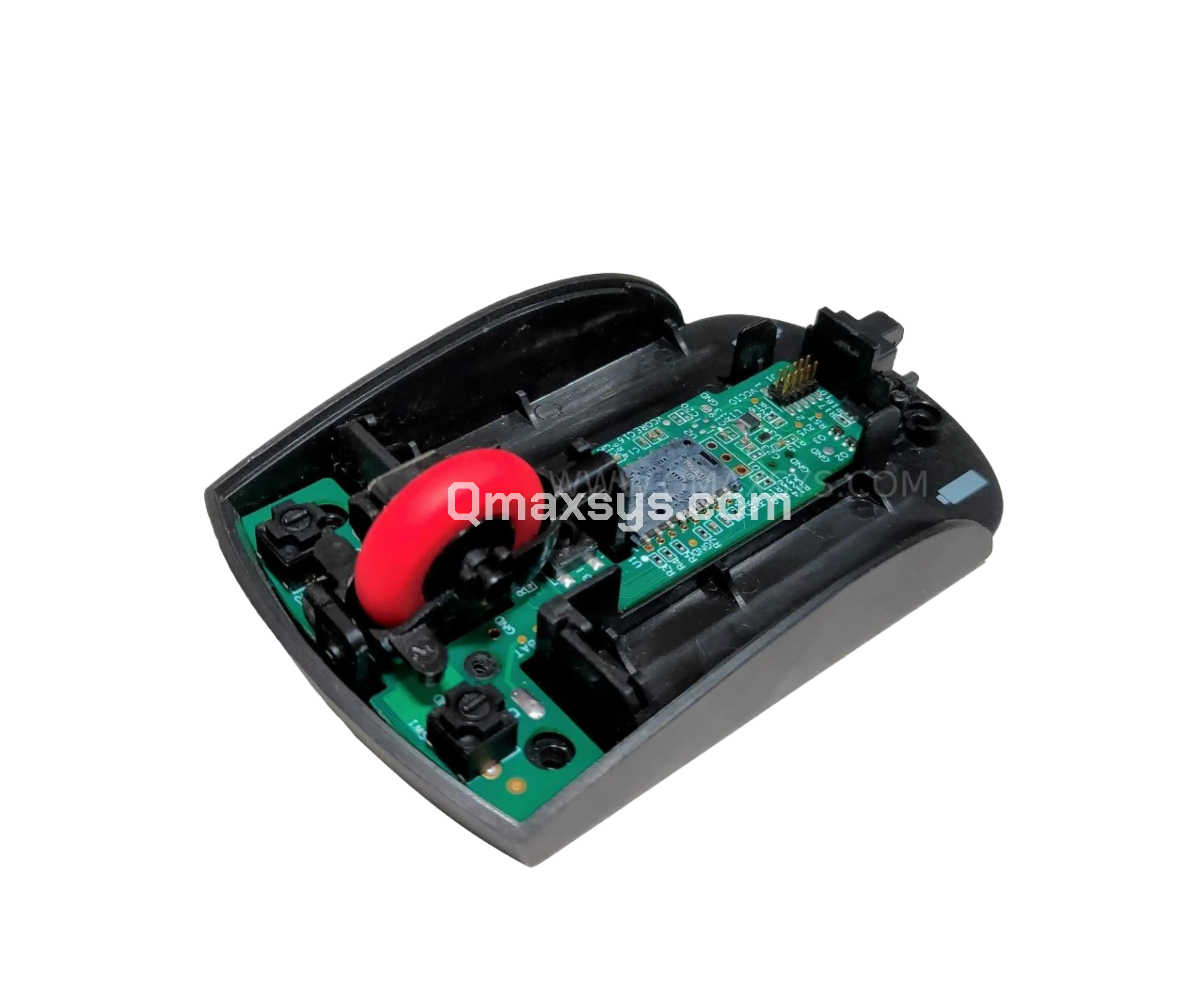
Ultra-Low-Power Bluetooth Mouse Reference Design Platform
Project Overview
Atmosic, a fabless semiconductor company pioneering ultra-low-power wireless SoCs, engaged Qmax Systems to develop a complete Bluetooth mouse reference design platform showcasing its BLE 5 silicon. Qmax delivered the full reference design — system architecture, hardware design, firmware, PCB design, prototype manufacturing, and full Design Verification Testing (DVT) — creating a production-ready HID mouse platform that Atmosic and its customers could take directly into high-volume consumer products.
The result demonstrated roughly 100× lower power consumption than contemporary wireless mice, translating to multi-year operation from a pair of AAA batteries.
Product Brief
The reference design is a full-featured BLE 5 optical mouse built around the Atmosic ultra-low-power Bluetooth SoC platform, which extends battery life by harvesting energy from ambient RF and waking its higher-power primary radio only when needed. A PixArt ultra-low-power IR optical sensor tracks X-Y motion over SPI, a quadrature Z-encoder handles scroll-wheel input, and three mouse buttons plus a dedicated pairing button complete the standard HID feature set.
The entire system — SoC, low-power QSPI flash, nano-quiescent-current power tree, chip antenna, and RF test port — fits on a compact 4-layer PCB shaped to a standard mouse form factor, running from two AAA cells.
Scope of Work
Qmax Systems delivered the complete reference design platform for Atmosic's BLE 5 silicon:
- System architecture definition for an ultra-low-power BLE 5 HID mouse reference platform
- Hardware design around the Atmosic BLE SoC, including RF front-end, chip antenna, and nano-quiescent-current power tree
- Bare-metal firmware development — HID mouse application, optical sensor driver, and aggressive power management
- Compact 4-layer PCB design in a mouse form factor with controlled-impedance RF routing
- Prototype manufacturing and full DVT, delivering a customer-ready reference design
Engineering Challenges
~100× lower power than contemporary wireless mice through system-wide energy budgeting
Every component selected for nano-amp quiescent current — Atmosic BLE SoC with RF harvesting, PixArt PMW3610 optical sensor, Macronix MX25R QSPI flash, and TI TPS62743 nano-quiescent buck converter — with power rails budgeted across the full sleep/active cycle
Highly optimized sleep/wake cycles for the primary radio
Ultra-low-power firmware architecture with deep sleep, retain, and hibernate modes scheduling the higher-power primary radio to activate only when motion or input demands it
Integrating RF energy harvesting into a consumer HID product's power architecture
Leveraged the Atmosic SoC's ambient RF energy harvesting to supplement battery power, extending operational life while maintaining standard HID mouse responsiveness and pairing behavior
Responsive, lag-free cursor tracking at 10 ms report cadence while mostly asleep
Optical sensor driver with 10 ms X-Y-Z polling and event-driven HID reporting, waking the radio only on motion interrupts or button events to sustain sub-10 ms cursor latency without continuous active power draw
Fitting complete RF design onto a compact mouse-shaped 4-layer PCB
4-layer PCB layout with controlled-impedance RF routing, antenna keep-outs, matching network, and RF switch connector for conducted test and certification — all within a ~1.85" × 2.75" mouse form factor
Hardware Components
Atmosic BLE 5 Ultra-Low-Power SoC
BLE 5 wireless platform with RF energy harvesting technology, waking the primary radio only when motion or input demands it
PixArt PMW3610 Optical Mouse Sensor
Ultra-low-power IR optical sensor connected via SPI with motion interrupt for event-driven wake and X-Y tracking
Macronix MX25R-Series QSPI Flash
Ultra-low-power QSPI flash for firmware storage and BLE bonding data with minimal standby current
TI TPS62743 Buck Converter
Nano-quiescent-current buck converter powering the 1.8 V rail from 2× AAA cells with sub-microamp standby
2.4 GHz Chip Antenna with RF Switch Connector
Integrated chip antenna with RF switch connector for conducted RF test and certification of the BLE link
Interfaces & Protocols
BLE 5 Wireless Link
HID-over-GATT mouse reports to the host PC or laptop — 3-button, scroll wheel, and pairing support
SPI — Optical Sensor
High-speed SPI interface to the PixArt PMW3610 for X-Y motion tracking with motion-interrupt wake
Quadrature Encoder — Scroll Wheel
Quadrature Z-encoder input for scroll-wheel position and direction detection
GPIO — Buttons & Pairing
Three mouse button inputs plus a dedicated pairing button with LED status indication
SWD / UART Debug
Serial wire debug and UART interfaces for firmware development, bring-up, and DVT
Firmware & Software
BLE HID Mouse Profile Implementation
HID-over-GATT mouse profile with 3-button, scroll, and pairing support on a custom-tuned BLE stack for the Atmosic SoC platform.
Ultra-Low-Power Firmware Architecture
Optimized sleep/wake scheduling across deep sleep, retain, and hibernate modes — minimizing active radio time while preserving instant wake on motion or button events.
Optical Sensor Driver
PixArt PMW3610 SPI driver with 10 ms X-Y-Z polling and event-driven HID reporting, triggering BLE transmission only when motion or input state changes.
Pairing, Bonding & Reconnection State Machine
One-touch unbond and LED status indication with robust bonding storage in QSPI flash and automatic reconnection to previously paired hosts.
Power Characterization & DVT Tuning
Full power characterization and firmware tuning through DVT to validate multi-year battery life from 2× AAA cells at the ~100× lower consumption target.
Technical Specifications
Summary
Qmax Systems delivered a complete ultra-low-power Bluetooth mouse reference design — architecture, hardware, firmware, PCB, prototypes, and full DVT — that showcases Atmosic's energy-harvesting BLE 5 silicon at its best. Consuming roughly 100× less power than contemporary wireless mice, the platform proved multi-year battery life from two AAA cells and gave the silicon vendor's customers a direct, production-ready path to market.
The project highlights Qmax's strength in reference design development for semiconductor companies — combining nano-quiescent hardware design, aggressive bare-metal power management, compact RF PCB layout, and full DVT validation into a turnkey platform that customers can take directly into high-volume consumer products.