AI-Vision UV-C Disinfection System for Hospital ICU Environments
Project Overview
A healthcare technology company set out to build an occupied-space UV disinfection system for hospitals — one that could safely run in ICUs, patient rooms, and bathrooms without exposing staff or patients to unsafe UV-C doses. They engaged Qmax Systems to take the concept from a blank sheet through to a field-ready product. Qmax owned the complete development lifecycle: system architecture, AI/computer-vision development, thermal and mechanical engineering, hardware and PCB design, embedded firmware, and prototype-to-small-volume manufacturing.
Given the safety-critical nature of the application, AI/computer-vision work — model development, edge optimization, and detection-accuracy validation — was the dominant engineering effort, accounting for more than 60% of total program hours. The program delivered 20 functional units that were validated in the customer's lab and deployed for field trials across multiple U.S. hospitals, and the system received UL approval (per UL 61010-1) to conduct in-hospital testing.
Product Brief
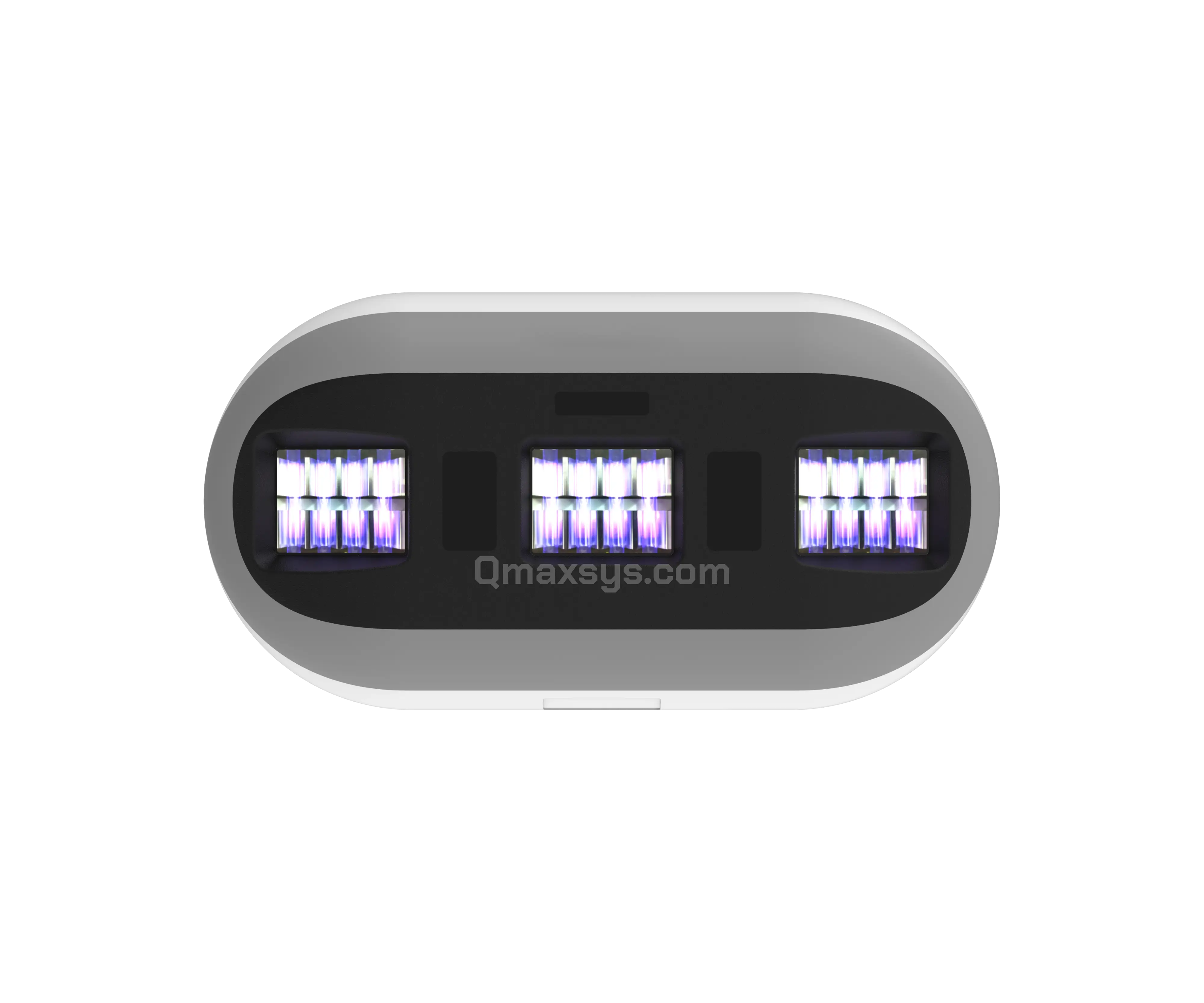
The device is a wall-mounted, AI-powered UV sanitizing lamp whose core value lies in its computer-vision safety system: a purpose-trained detection model running on an NVIDIA Jetson Nano continuously interprets a dual-camera, IR-illuminated feed to find people in the room, estimate their distance from the lamp, and calculate cumulative UV exposure dose in real time.
Three 222 nm UV-C arc lamps provide the disinfection source, but it is the AI layer that makes occupied-space operation possible — if a person moves too close to the lamp or approaches the programmed exposure limit, the vision system triggers an automatic shutoff. This closed-loop, AI-driven safety architecture is what enables continuous disinfection cycles in occupied clinical spaces without manual intervention.
Scope of Work
Qmax Systems executed the complete development lifecycle for this safety-critical, AI-first healthcare product:
- AI/computer-vision architecture, model development, training, and edge deployment — the single largest engineering workstream on this program
- Dataset collection, curation, and model training for hospital-specific person-detection scenarios
- Edge-AI inference optimization and performance tuning on NVIDIA Jetson Nano
- Depth/distance-estimation and UV exposure dose-calculation algorithm development
- Thermal engineering and airflow design for the onboard AI compute module
- Mechanical enclosure design, industrial design, and DFM for a compact, clinical wall-mounted form factor
- Hardware design and schematic entry for lamp-drive, power, and sensor electronics
- PCB design and layout for the main controller board and UV lamp power-supply boards
- Embedded firmware development for lamp control, safety interlocks, and dose tracking
- Prototype fabrication, functional test, calibration, and small-volume manufacturing support
Engineering Challenges
Reliable real-time person detection across diverse hospital environments on edge hardware
Trained and fine-tuned a lightweight CNN on a hospital-representative dataset covering patients in beds, moving staff, bedding, and equipment clutter — optimized for real-time inference on the Jetson Nano
Distance estimation across 0.5 m–5 m range without a dedicated depth sensor
Developed a dual-camera depth/distance-estimation algorithm using the two IR-illuminated camera feeds, enabling lamp-to-person ranging for exposure dose calculation without adding a dedicated depth sensor
Fitting model inference within the Jetson Nano's limited edge-compute budget
Model optimization and quantization tuned for real-time inference within the Jetson Nano's compute and power budget while meeting the required detection and update cycle
Balancing false positives (nuisance shutoffs) against false negatives (unsafe exposure)
Detection-accuracy tuning across hospital scenarios to eliminate nuisance shutoffs that cut disinfection uptime without introducing false negatives that risk unsafe UV exposure to occupants
Sustaining detection accuracy in low-light and IR-only operating conditions
Low-light, IR-synchronized inference pipeline with dedicated IR illuminator control for continuous day/night operation in clinical lighting conditions
Curating a hospital-representative training dataset with limited real-world data
Structured dataset collection and curation covering patients in beds, moving staff, and equipment-dense rooms — with augmentation and fine-tuning strategies to compensate for limited initial field data
Dissipating Jetson Nano heat inside a sealed, IP40-intent enclosure
Thermal engineering with aluminum heatsinks, engineered inlet/exhaust airflow paths, and an exhaust fan sized to keep the AI processor within limits without compromising ingress protection intent
Quiet thermal management acceptable for patient-occupied rooms
Inlet/heatsink/exhaust airflow design balancing AI processor thermal headroom against acoustic limits suitable for ICU and patient room deployment
Packaging AI compute, cameras, three UV-C lamps, and power electronics in a compact enclosure
Mechanical and industrial design fitting Jetson Nano, dual cameras, three 222 nm lamp assemblies, high-voltage drivers, and SMPS within a 345 × 150 × 181 mm, ~3 kg wall-mounted enclosure while holding IEC 62262 IK03 impact-rating design intent
Prototype enclosures durable enough for hospital field trials with electrical safety pre-compliance
Vacuum-cast ABS outer enclosures with camera-concealing covers and powder-coated mild-steel internal chassis — validated against IEC 61010-1:2010/AMD1:2016 electrical safety pre-compliance requirements for repeated hospital field trials
Hardware Components
NVIDIA Jetson Nano Edge-AI Module
Onboard compute running the purpose-trained person-detection CNN, dual-camera depth estimation, and cumulative UV exposure dose calculation in real time
Three 222 nm UV-C Arc Lamps
12 W each — disinfection source enabling occupied-space UV sanitization when the AI safety system confirms safe operating conditions
Custom High-Voltage Lamp-Driver Boards
24 VDC input to ~4000 VAC output — dedicated driver boards for each UV-C arc lamp with status and fault feedback to the controller
24 VDC SMPS Primary Power Supply
Main switched-mode power supply with fused AC mains input connector for universal mains entry
Onboard DC-DC Regulator (5 VDC)
Regulated 5 VDC rail powering the Jetson Nano and auxiliary control electronics from the 24 VDC distribution bus
Dual Cameras with IR Illumination
Two camera modules with IR illuminator for day/night presence detection and dual-camera distance estimation
Thermal Management Assembly
Aluminum heatsinks and exhaust fan with engineered airflow paths for Jetson Nano thermal dissipation inside the sealed enclosure
Vacuum-Cast ABS Enclosure & Steel Chassis
Powder-coated mild-steel internal chassis and mounting frame with vacuum-cast ABS outer shell and camera-concealing covers for clinical wall-mount deployment
Interfaces & Protocols
Camera-to-AI Video Interface
Real-time dual-camera image capture feeding the Jetson Nano inference pipeline for person detection and distance estimation
IR Illuminator Control
Low-light imaging support synchronized with the AI inference pipeline for continuous day/night operation
AI GPIO to Lamp-Driver Control
Jetson Nano GPIO/control interface to lamp-driver boards for automatic on/off switching driven directly by AI detection output
Lamp Status & Fault Feedback
Status and fault lines from each high-voltage driver board back to the main controller for safety interlocks and diagnostics
24 VDC Power Distribution Bus
Primary DC bus distributing power to lamp drivers, DC-DC regulator, and control electronics
Regulated 5 VDC Rail
Powers the AI compute module and auxiliary electronics from the onboard DC-DC regulator
Universal AC Mains Input
Fused AC connector interface to the 24 VDC SMPS for mains-powered wall-mounted operation
High-Voltage Lamp Interface
~4000 VAC output from lamp-driver boards to the three UV-C arc lamp assemblies
Sensor Data Interfaces
Supporting distance estimation inputs and cumulative UV exposure dose calculation from dual-camera ranging
Data Logging / Network Provision
Wired/network data interface provision for detection event logging, exposure dose records, lamp runtime, and future cloud/OTA firmware extension
Firmware & Software
Hospital Dataset Collection & Curation
Structured dataset gathering for hospital-specific person detection — patients in beds, moving staff, equipment clutter, and varied lighting conditions.
Lightweight CNN Training & Fine-Tuning
Purpose-trained person-detection model developed and fine-tuned for real-time edge inference on the Jetson Nano across diverse clinical scenarios.
Edge Model Optimization & Quantization
Model compression and quantization to fit inference within the Jetson Nano's compute and power budget while maintaining required detection accuracy and update cadence.
Dual-Camera Depth / Distance Estimation
Algorithm development for lamp-to-person ranging across the 0.5 m–5 m required range using dual-camera geometry without a dedicated depth sensor.
Cumulative UV Exposure Dose Engine
Real-time dose-calculation engine using distance-based lookup tables to track cumulative UV exposure per detected person and trigger shutoff at programmed limits.
Detection-Accuracy Tuning
Sensitivity calibration to eliminate false positives causing nuisance shutoffs while preventing false negatives that risk unsafe UV exposure in occupied spaces.
Low-Light IR-Synchronized Inference Pipeline
Continuous day/night operation pipeline coordinating IR illuminator timing with camera capture and AI inference for reliable detection in dim clinical environments.
Automatic Lamp Shutoff & Fail-Safe Control
Embedded firmware driving lamp on/off control and safety interlocks directly from AI detection output — immediate shutoff on proximity or dose-limit breach.
On-Device Self-Test & Calibration
Diagnostic routines for camera subsystems, AI inference health checks, and calibration workflows supporting field deployment and maintenance.
Data-Logging Architecture
On-device logging of detection events, exposure dose, and lamp runtime with firmware architecture provisioned for future cloud connectivity and OTA extension.
Technical Specifications
Summary
Qmax carried this AI-enabled UV disinfection system from a blank-sheet concept to a fully validated product. With AI/computer-vision development accounting for more than 60% of total engineering effort, the program's hardest problems were in detection accuracy, edge-inference performance, thermal management of the onboard AI compute, and mechanical packaging — not the electrical hardware itself.
Qmax delivered 20 functional prototypes that were evaluated in the customer's lab and deployed for field trials across multiple U.S. hospitals. The system received UL approval (per UL 61010-1) to conduct in-hospital testing and successfully met applicable IEC 61010-1:2010/AMD1:2016 electrical safety pre-compliance requirements.
The program demonstrates Qmax Systems' ability to execute complex, AI-first, safety-critical hardware products end-to-end — spanning computer vision, thermal and mechanical engineering, PCB design, and small-volume manufacturing.